Yes, you can write off client meals, but the IRS only lets you deduct 50% of the cost. The rules around what counts are tighter than most people think.

The basic rule
Here's the deal. A client meal is 50% deductible if it has a real business purpose and you or an employee is physically present at the table. That's it. You spend $80 taking a client to lunch at The Collins Quarter, you deduct $40 from your taxable income. The other $40 comes out of your pocket. Full stop.
This trips people up because the math feels wrong. Why only half? The IRS figures you had to eat anyway, so they only let you write off the "business" portion of the meal. Whether that logic holds up is beside the point. The rule is the rule.
There was a brief window in 2021 and 2022 where restaurant meals got a 100% deduction as pandemic relief. That's gone. It expired. If you're still operating on the assumption that you get the full meal written off because somebody told you about it during COVID, you're going to have an unpleasant conversation with your tax preparer.
The IRS assumes half of every meal is just you being a person who eats food.
What actually qualifies as a client meal
The meal needs a valid business purpose. That doesn't mean you need a signed contract at the end of the appetizers. It means you're meeting with someone in the active conduct of your business. Current clients, prospective clients, vendors, suppliers, professional advisors, agents. All of these count as business associates. You can deduct a meal with any of them at 50%.
Say you're a photographer and you take a wedding planner to coffee to talk about a referral arrangement. That's a business meal. Say you're an electrician and you buy lunch for a general contractor who could send you work on renovation projects. Same thing. Say you run a food truck on Broughton Street and you sit down with a corporate event coordinator who's thinking about booking you for their holiday party. All business meals. All 50% deductible.
What doesn't count is lunch with your buddy who happens to own a business three states away and you talked about business for ten minutes. There has to be a real connection between the meal and your actual trade or business. The IRS doesn't define "real connection" with surgical precision, which is exactly where judgment calls come in. More on that in a minute.
The lavish rule
The meal can't be lavish or extravagant. The IRS doesn't give you a dollar amount for what crosses that line, which is both frustrating and typical. A $40 lunch at a casual spot is clearly fine. A $600 dinner with a bottle of premium wine at a high-end steakhouse starts to look like something else.
Context matters. If you're a barber taking a fellow barber to a $25 lunch to talk shop, that's ordinary. If you're a consultant taking a prospective client to a $400 dinner, the IRS might ask whether that's really a business meal or a personal evening out with a receipt attached. There's no bright-line test. It's a facts-and-circumstances call. Getting it wrong means losing the deduction entirely and potentially triggering scrutiny on other meals you've claimed.
Documentation: where meals go to die
This is where most self-employed people lose deductions they legitimately earned. You had the meal. It was for business. You paid for it. But you can't prove it, so the IRS disallows it.
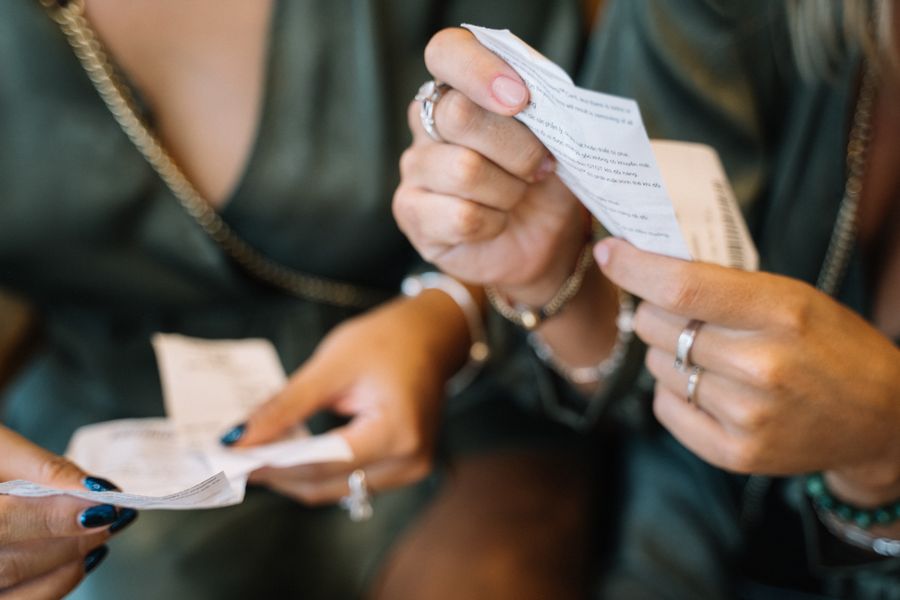
You need a receipt for business meals of $75 or more, and you should note the business purpose and who was there. That's the minimum. The receipt alone doesn't cut it if it doesn't show who you ate with and why. A credit card statement that says "VICTORY NORTH $72" tells the IRS nothing about whether that was a client meeting or your anniversary dinner.
Here's what good documentation looks like. You keep the receipt. On it, or in a log, or in a note in your bookkeeping software, you write: "Lunch with Sarah at The Grey, March 14. Sarah is an event coordinator at a local hotel. Discussed catering contract for Q3." That's it. Date, place, who, what business relationship, what you talked about. Ten seconds of effort that saves the deduction if anyone ever asks.

The IRS disallows meal expenses that don't have appropriate backup documentation. That's not a maybe. That's a firm rule from their own guidance. The penalty for getting this wrong isn't just losing the meal deduction. If the IRS decides your records are bad enough, it opens the door to questioning everything else on your return. More on the penalty math in a minute.
The entertainment trap
This is where people get burned badly. Entertainment expenses are not deductible. Sporting event tickets, concert tickets, golf outings, club memberships, theater tickets. None of it. The Tax Cuts and Jobs Act killed entertainment deductions starting in 2018, and they haven't come back.
But here's the wrinkle that catches people. If you buy food and drinks at an entertainment event and they're billed separately from the entertainment, the food portion can be 50% deductible. So if you take a client to a Savannah Bananas game and you buy hot dogs and beer from the concession stand on a separate receipt, that food might qualify as a business meal. The game tickets? Gone. Not deductible.
If the food and entertainment are on one combined charge, like a luxury suite package where the food is included in the ticket price, you don't get to carve out the meal portion. It's all entertainment. It's all nondeductible.
This is a judgment call that depends on how the venue bills things and how you pay. Getting it wrong means either claiming a deduction you're not entitled to, which is an audit risk, or leaving money on the table that you could have legally claimed.
Travel meals vs. client meals
Meals while you're on business travel are also 50% deductible, and they follow slightly different rules than client meals at home. You don't need a business associate present for a travel meal. You're eating because you're on the road for work, and the IRS accepts that.
Say you're a photographer who flies to Atlanta for a two-day shoot. Your meals during that trip are 50% deductible whether you eat alone or with a client. But you can't deduct meals for a spouse or family member who came along and isn't part of your business. The deduction covers you, the business owner or employee, not your plus-one.
Transportation to and from the meal isn't part of the meal cost. Your Uber to the restaurant is separate. It might be deductible as a travel expense depending on context, but it doesn't roll into the meal deduction.
The 100% meals
Some meals still get full deductibility, and it's worth knowing which ones so you don't accidentally apply the 50% rule to everything.
Food offered to the public for free is 100% deductible. If you're a barber and you put out a pot of coffee and donuts for clients waiting in your shop, that's fully deductible. It's promotional, and the IRS treats it differently from a sit-down meal.
Meals included as taxable compensation to someone who isn't an employee, like an independent contractor, can be 100% deductible because they're being reported as income to that person. Your office holiday party or company picnic is 100% deductible if it's open to all employees and not lavish.
But starting in 2026, employer-provided meals for the convenience of the employer, like food you bring in to keep people working late, are generally no longer deductible. If you've been writing off pizza for your team during busy season, that deduction is going away. The rules shifted again, and this is a moving target that depends on the tax year you're in.
The penalty math
Here's the open loop from earlier. When you lose a meal deduction because your documentation is bad, you don't just lose the $40. You lose $40 of taxable income, which means you pay tax on $40 you thought was gone. At a self-employment tax rate plus income tax, that $40 might cost you $12 or $15 in actual tax. Not catastrophic for one meal.
But the IRS doesn't audit one meal. They audit a category. If you claimed $3,200 in meal expenses over the year and your documentation is shaky, they disallow the whole category. Now you're paying tax on $3,200 you thought was deducted. At a blended rate, that's $800 to $1,000 in unexpected tax, plus penalties and interest on top. One bad receipt habit turns into real money.
This is the work Nomadica does for clients. We help you set up the bookkeeping categories so meals are tracked correctly from the start. We tell you which meals are 50% and which are 100% so you're not guessing at year-end. When a meal sits in a gray area, like that dinner that might be lavish or that entertainment event where the food was kind of separately billed, we make the judgment call based on how the IRS has actually treated similar situations. You can absolutely track your own meals. But if you're spending $3,000 a year on business meals and hoping your receipts are good enough, that's a gamble with real odds.
What to do right now
Pull up your meal expenses from the last three months. For each one, check whether you have a receipt and a note about who was there and why. If you're missing either, start writing it down tonight. Five words on the receipt is enough: "lunch with client, discussed project." Future you will thank present you when tax season rolls around.
If you want help sorting out which meals are deductible and which ones are quietly creating audit risk, send us your last year's meal expenses. We'll look at them and tell you what's solid, what's shaky, and what to fix before it costs you. No charge for the look. We just like knowing the meals we're deducting for clients are actually going to hold up.