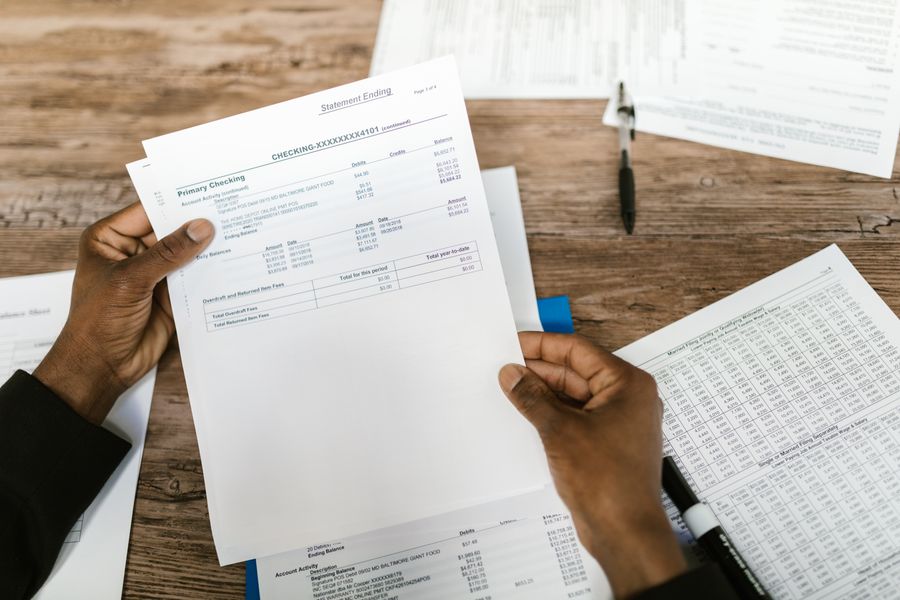
Yes, you owe taxes four times a year. If you're self-employed and you expect to owe at least $1,000 in tax for the year, the IRS wants estimated payments quarterly instead of one big check every April.
It feels annoying, but here's the logic. When you had a W-2 job, your employer pulled taxes out of every paycheck before you saw the money. Nobody's doing that for you now. The IRS runs a pay-as-you-go system, which is exactly what it sounds like: you pay as you earn. Four times a year you estimate what you owe for the previous few months and send it in. Miss those payments, or send too little, and you get hit with an underpayment penalty. More on that in a minute.

What you're actually paying for
Your quarterly payment covers two things, and they behave differently.
Self-employment tax is Social Security and Medicare. When you were a W-2 employee, your employer paid half of this and you paid half through withholding. Now you're both the employer and the employee, so you pay both halves. The rate is 15.3% on your net earnings up to $176,100 for the 2025 tax year. That's 12.4% for Social Security and 2.9% for Medicare. Once your income passes $176,100, the Social Security portion stops but the 2.9% Medicare keeps going. High earners, generally individuals with earned income of $200,000 or more or married couples at $250,000 and above, pay an extra 0.9% in Medicare tax on top of that.
Income tax is the other piece. This is the tax on your profit, which is your revenue minus your business expenses and any other eligible deductions. Same income tax you've always dealt with. Just nobody's withholding it for you.
Say you're a photographer in Ardsley Park who expects to pull in $85,000 this year from weddings and portrait sessions. You've got about $20,000 in expenses: gear insurance, software subscriptions, mileage, a second shooter for big weddings. Your net profit is $65,000. You'll owe self-employment tax on that $65,000 plus income tax depending on your filing status and other deductions. Form 1040-ES, the worksheet the IRS provides, walks you through the calculation. You fill in your expected income, subtract expenses and deductions, figure the tax, and divide by four.
That's it. Estimate what you'll owe for the year, divide by four, send in one quarter every three months.
When the payments are due
The IRS splits the year into four payment periods, and they're not as clean as you'd expect. Here are the deadlines for the 2026 tax year:
| Period Income Earned | Payment Deadline |
|---|---|
| January 1 through March 31 | April 15, 2026 |
| April 1 through June 30 | June 16, 2026 |
| July 1 through September 30 | September 15, 2026 |
| October 1 through December 31 | January 15, 2027 |
Notice that second payment. June 16, not June 15, because June 15 falls on a Sunday in 2026. When a deadline lands on a weekend or holiday, it shifts to the next business day. The last payment of the year is due in January of the following year, which throws people off. You're paying for the previous year's fourth quarter while you're already three weeks into the new one.
If a hurricane rolls through coastal Georgia and a federal disaster is declared, the IRS extends these deadlines for affected taxpayers. That's happened plenty in recent years. If you're in a declared disaster zone, check the IRS disaster relief page before you panic about a deadline.
How to actually send the money
You don't file a return for quarterly taxes. You just pay. That distinction trips up almost every first-timer because "filing quarterly taxes" sounds like you're submitting paperwork four times a year. You're not. You're sending money.
The easiest way is the Electronic Federal Tax Payment System, or EFTPS. You set up an account at EFTPS.gov, link your bank account, and schedule payments. You can also pay directly through the IRS website using their Direct Pay tool, or through your IRS online account. If you prefer paper, Form 1040-ES includes voucher slips you mail in with a check.
You don't file a return for quarterly taxes. You just pay.
One thing to watch: if you're mailing a check, include the voucher so the IRS knows which year and which quarter the payment belongs to. Without it, your money can end up in the wrong bucket and you'll spend months sorting it out. If you pay online, the system handles that for you.

What happens when you get it wrong
Let's talk about that penalty. If you underpay during the year, the IRS charges interest on the amount you should have sent but didn't. The rate changes periodically, but the mechanism is simple: you owe interest on the gap between what you paid and what you should have paid, calculated from the quarter the underpayment started.
Say you're an electrician in Pooler who had a killer spring. You landed two big commercial rewiring jobs back to back and pulled in $40,000 in profit between January and March. But you didn't send in a quarterly payment because you weren't sure how this worked yet. The IRS expected roughly $6,000 from you for that quarter, counting both income tax and self-employment tax. You sent zero. Now you're accruing underpayment interest from April 15 until the day you catch up. It's not catastrophic. But it's money you're giving away for no reason.
The penalty applies even if you end up getting a refund when you file your annual return. That's the part that feels unfair. You overpaid later in the year, you're due money back, but the IRS still charges interest on the quarters where you underpaid. The system looks at each quarter independently.
There's also a filing threshold to know. If your net earnings from self-employment are $400 or more, you have to file an annual tax return. This is separate from the quarterly payment requirement. You could owe no quarterly payments and still need to file at year-end because you crossed the $400 line.
The safe harbor rules
The IRS gives you two ways to dodge the underpayment penalty entirely, and they're worth knowing cold.
Safe harbor one: You owe less than $1,000 in tax for the year after subtracting withholding and credits. If you're close to the line, keep an eye on this.
Safe harbor two: You paid in at least 90% of your current year tax liability or 100% of your prior year tax liability through withholding and quarterly payments. The 100% rule means if you owed $8,000 last year and you send in $8,000 across four quarterly payments this year, you're protected even if your actual tax bill turns out to be $12,000. You'll still owe the $4,000 difference when you file. But no penalty interest.
That 100% figure bumps to 110% if your adjusted gross income exceeds $150,000, or $75,000 if you're married filing separately. So a food truck owner on Tybee who had a breakout year last year and cleared $160,000 in AGI needs to cover 110% of last year's tax to use the safe harbor. This is the kind of detail that catches people who read the headline but skip the fine print.
If you earned at least two-thirds of your income from farming or fishing, different rules apply. You only need to pay in two-thirds of your current year tax or 100% of your prior year tax, and there's a single estimated tax payment date of January 15. If you file and pay in full by March 1, estimated payments aren't required at all.
What if your income swings around
This is where quarterly taxes get genuinely tricky, and where a lot of first-timers call us.
The IRS expects roughly equal payments, but your income probably doesn't arrive in roughly equal chunks. A barber on Broughton Street might do great during tourist season and slow down in January. A wedding photographer might book 70% of their revenue between May and October. If you just divide your annual estimate by four and send equal payments, you'll overpay in slow quarters and scramble in busy ones.
Here's the thing. You can adjust. If your income drops, you send less that quarter. If you land a big contract and your income jumps, you send more. Form 1040-ES has an annualized income worksheet that lets you calculate each payment based on what you actually earned that period rather than a flat quarter of your annual estimate. It's more work. But it keeps you from sending the IRS money you need for rent in March and hoping you earn it back by September.

The trap is that the annualized method requires you to track your income carefully through the year. If your bookkeeping is a shoebox of receipts and a rough memory, you can't use it accurately. And if you guess wrong on the annualized worksheet, you're back to penalty territory. This is the judgment-call zone where getting it right saves real dollars and getting it wrong costs real dollars. It's exactly the kind of work Nomadica handles for clients who'd rather not spend their evenings with IRS worksheets.
A note on state taxes
Don't forget your state. The sources we work with focus on federal quarterly payments, but most states that have an income tax also want estimated payments from self-employed people. Georgia has its own estimated tax requirements. Check the current Georgia Department of Revenue guidance or ask us about your state obligations before you assume the federal payment is the only one on your calendar.
Getting started
If this is your first year, you don't have a prior year tax return as a self-employed person to use as a baseline. You're estimating. Pull together your expected revenue, subtract your expected business expenses, work through the Form 1040-ES worksheet, divide by four, and make your first payment through EFTPS or Direct Pay before the deadline.
If you're not sure whether your estimate is in the right ballpark, that's a good reason to talk to someone before you send the IRS a number you guessed at over lunch. You can send us your projected income and expenses for the year and we'll run the calculation, flag the safe harbor that fits your situation, and set up a payment schedule that matches how your money actually arrives. One email gets it started.